


Airbnb’s new rules could change how much you know about your guests and what you can ask them to do. Here’s what independent hosts need to know.
At a Glance (TL;DR)
From November 20, 2026, Airbnb’s new rules will restrict what hosts can require from guests, including rental agreements, personal contact information and checkout tasks. While some changes are reasonable, others raise serious questions about guest safety, property protection and how much control independent hosts retain over their businesses. Here’s what you need to know, why it matters and what you can do about it.
Three actions you can take today:
1. Make your voice heard. Submit your feedback to Airbnb and explain how these restrictions affect your property and business.
2. Discover other vacation rental listing platforms that could help you attract guests and reduce your dependence on Airbnb. Download my FREE Alternative Vacation Rental Listing Platforms Directory and start taking back control of your bookings.
3. Build Your Own Direct Booking Website. Stop relying entirely on third-party platforms to bring you guests. Your own website gives you greater control over your bookings, guest relationships and marketing, without being at the mercy of constantly changing platform rules. My book, 5-Star Hosting Made Simple that will help you through the practical steps of building and running a successful short-term rental business, including how to set up a simple direct booking website without the fuss.
Imagine handing someone the keys to your property without knowing their personal contact details or being able to carry out your own guest registration procedures.
You own the property. You’re responsible for its security, maintenance and the safety of the guests staying there.
But Airbnb increasingly wants to decide how you manage that relationship.
And now, with new rules taking effect for bookings made from November 20, 2026, the company is tightening its control over two important areas of hosting:
1. The information you can collect about your guests.
2. What you can reasonably ask them to do before checkout.
Much of the online discussion has focused on checkout chores. But I think the restrictions on guest information deserve more attention as they affect how you run your business.
Let’s look at what’s changing and what it means for independent hosts.
1. Your Property, but how much can you know about your guests?
Under Airbnb’s new policy, hosts will generally be prohibited from asking guests for personal information, including their email address, telephone number, home address or copies of identity documents, unless a specific exception applies.
Hosts will also face restrictions on requiring guests to sign separate rental agreements or register through third-party websites and applications.

Airbnb’s position is that it already verifies the identity of the person making the reservation.
But here’s my question.
Is Airbnb’s verification enough when you’re the person responsible for the property?
Airbnb might know who made the booking. But what about the other people staying there? What happens if you need to contact a guest urgently? And what if something goes seriously wrong?
Airbnb knows your guest. Do you?
Airbnb does provide a contact number after a booking is confirmed. However, some guests are now being assigned temporary telephone numbers rather than being connected through their personal numbers.
Currently, this feature is limited to certain users in the United States and Canada, but Airbnb says it intends to expand into additional markets.
These temporary numbers can be used for calls and text messages, but they don’t support WhatsApp and expire two days after checkout.
That’s a significant change in how hosts communicate with guests.
For years, I’ve advocated building a relationship with guests from the moment they book. Good communication is one of the foundations of excellent hospitality.
But it’s also a practical necessity.
Imagine a burst pipe, a fire alarm, a security incident or another emergency when you urgently need to contact someone staying at your property.
Shouldn’t you have a reliable way to reach them?
And shouldn’t you have some say in how you establish that relationship?
What about guests who have bad intentions?
Let’s be clear. The overwhelming majority of guests are responsible people who simply want to enjoy their vacation or weekend away.
But every experienced host knows that things can go wrong.
Unauthorized parties, additional occupants, deliberate damage and theft are real risks.
Identity verification doesn’t guarantee good behavior. Nor does verifying the booking guest necessarily tell you who else will be staying.
I’m concerned that limiting the information hosts can collect could make it more difficult to protect their properties and deal with problems afterward.
I’m not suggesting that every guest should be treated with suspicion. Far from it.
But protecting guest privacy shouldn’t mean removing reasonable safeguards for property owners.
Are there exceptions?
Yes, and they’re important.
Hosts can still collect information where it’s necessary to comply with applicable laws or documented community association requirements.
When we owned our vacation rental at Villa Ibis in Panama, the community had registration and security requirements. Guest information was part of the process of allowing visitors into the resort.
Many European countries also have legal guest-registration requirements.
In Portugal, for example, accommodation providers must collect and report prescribed information about foreign guests under the country’s accommodation reporting requirements.
Airbnb’s new policy recognizes legal obligations of this kind. Hosts must explain what information is required and why, disclose it in their listing before booking, and collect only what is necessary.
However, a legal requirement to record identification details does not automatically mean a host is entitled to retain a photograph or copy of a guest’s passport. Hosts must follow the specific requirements of their local laws.
The restrictions on rental agreements also have four important exceptions.
Hosts may require a separate rental agreement when it is:
- Required by law or community association rules, including certain building security requirements.
- Necessary to provide access to an optional amenity, such as a golf cart rental.
- Connected with a stay of 28 nights or longer.
- Related to an Airbnb Luxe listing.
Any permitted agreement must be relevant to the stay, comply with Airbnb’s policies and be disclosed in the designated section of the listing.
But what about the independent host who simply wants guests to sign a reasonable rental agreement setting out their responsibilities?
If none of those exceptions applies, Airbnb generally won’t permit the host to require it.
And Airbnb makes clear that it doesn’t enforce the terms of host-imposed contracts.
The host remains responsible for protecting the property, but Airbnb is deciding which contractual protections the host can require.
What if you don’t have a legal reason to collect guest information?
This is where independent hosts need to be particularly careful.
Airbnb’s policy generally prohibits soliciting personal contact details, even after the reservation is confirmed. So simply asking guests to complete a separate registration form to obtain their email address or telephone number isn’t a reliable workaround.
And the restrictions go further.
Airbnb’s updated policy specifically addresses Wi-Fi portals that collect guest email addresses or other personal information. These are generally prohibited unless the listing is a hotel or resort, or another permitted exception applies.
Hosts also cannot simply make registration through a third-party guest app compulsory as a way of obtaining information Airbnb doesn’t otherwise permit them to collect.
Optional apps that help guests enjoy their stay can still be offered, subject to Airbnb’s requirements.
This matters because many independent hosts have invested in technology and systems to improve communication and develop direct relationships with guests.
But it also raises a wider question.
Should a booking platform have this much control over how an independent business builds relationships with its customers?
That doesn’t mean you have to abandon the personal relationship with your guests.
You can still send a warm welcome message, provide helpful information, offer local recommendations and make yourself available throughout their stay using Airbnb’s messaging system.
You can also offer optional guest services and experiences through permitted arrangements, without making personal-data collection a condition of accommodation.
And where Airbnb permits it, you can check a guest’s identification in person at check-in, provided the requirement was disclosed in your listing. Without an applicable exception, you cannot retain a copy.
My advice? Build the relationship through great hospitality, not compulsory forms.
And if you rely on guest contact information for safety or operational reasons, review your procedures now rather than waiting until November.
2. Airbnb is rewriting the checkout rules
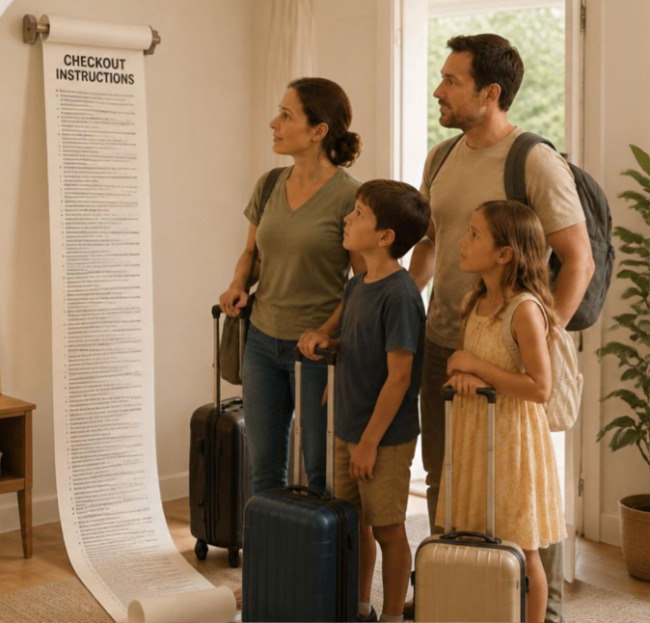
This is the part of the announcement that’s attracting the most attention.
From November 20, Airbnb will restrict the chores hosts can ask guests to perform before leaving.
For example, hosts generally won’t be allowed to require guests to strip beds, start laundry, stack and start the dishwasher, put away dishes or place garbage outside.
But they can request guests to put used dishes in the sink, gather towels, separate recycling into indoor bins and switch off the air conditioning when leaving.
And I have to say, I agree with Airbnb on much of this.
I’ve stayed in properties where the checkout instructions were practically a cleaning schedule.
Strip the beds. Wash the towels. Empty the dishwasher. Vacuum the floors. Take out the garbage.
And then pay a substantial cleaning fee!
That’s not my idea of hospitality.
Guests are paying to stay in your property, not to clean it for the next arrival.
Cleaning chores or basic hygiene? There’s a difference.
I agree that guests shouldn’t be expected to do a list of chores before checkout.
But what about basic hygiene?
Consider a vacation rental where it’s hot, or beside a river or surrounded by woodland, where exposed food and garbage can attract insects, rodents or other wildlife.
In that situation, asking guests to deal responsibly with food waste isn’t necessarily about saving the cleaner a few minutes. It may be about protecting the property.
And what happens if the cleaner isn’t arriving until the following day?
Airbnb says it will consider local circumstances, but hosts need clearer guidance about where reasonable hygiene precautions end and prohibited cleaning tasks begin.
A checkout request that makes little sense in a city apartment might be essential in a remote vacation rental.
That’s why I believe hosts need some flexibility to establish sensible requirements based on the location, facilities and particular risks of their properties.
What happens when an automated (AI) system goes wrong?
There’s another concern that hosts should be aware of.
Airbnb’s new listing editor checks requests and flags wording that may not comply with its policy.
Thibault Masson, founder of Rental Scale-Up, tested the new system and found some inconsistencies.
One particularly interesting example involved asking guests to use an animal-proof garbage bin because of bears.
The instruction was flagged by the editor, even though Airbnb itself gives animal-proof bins in bear country as an example of a potentially reasonable request.
That’s not proof that Airbnb would ultimately reject the instruction. But it does highlight the limitations of automated checks.
And passing the initial check doesn’t necessarily guarantee that a request will be accepted if it’s reviewed later.
When an instruction is intended to protect guests, wildlife or the property itself, hosts need clear and consistent guidance, not uncertainty about how an automated system will interpret it.
What’s the difference between house rules and requests?
Airbnb has introduced a clearer distinction between house rules and requests.
House rules cover seven standard areas:
- Maximum overnight guests
- Quiet hours
- Pets
- Smoking
- Events
- Commercial photography and filming
- Locking up at checkout
Guests are required to follow those rules.
Other instructions, including permitted checkout tasks, are generally treated as requests.
Guests are encouraged to follow requests, but they aren’t enforceable in the same way as house rules.
That’s a significant distinction, particularly for smaller hosts who manage their own cleaning and turnovers.
If your changeover depends on guests completing certain tasks, you may need to rethink your arrangements.
And be careful about leaving old checkout instructions in your guest guide or sending additional rules after booking. Airbnb says rules and requests must be disclosed in the designated listing section when the reservation is made.
You can remind guests of existing rules during their stay, but you cannot introduce new ones afterward through messages, signs or other instructions.
What happens if you don’t comply?
Airbnb’s new listing editor can flag instructions that may breach the policy.
Hosts will have opportunities to review and appeal those decisions.
But unresolved or repeated violations could result in warnings, notices appearing on listings and reduced visibility in Airbnb search results.
In other words, this isn’t just guidance about better hospitality.
Airbnb can penalize hosts who don’t follow its interpretation of what’s reasonable and could even remove you from their platform.
3. What should independent hosts do now?
You don’t need to panic, but you do need to review your listing and procedures before November 20.
Here is the list of priorities:-

- Review your guest information requirements. Are you collecting information because the law requires it, or simply because you’ve always done it that way?
- Check your rental agreements. If you require guests to sign one, make sure it falls within Airbnb’s permitted exceptions.
- Review your check-in procedures. Understand what identification you can check, what you can retain and how you can contact guests.
- Update your house rules and checkout instructions. Make sure they’re in the correct section of your Airbnb listing, and check whether the new editor flags any of your requests.
- Check your cleaning arrangements. If you depend on guests doing part of the turnover, you may need to adjust your schedule or costs.
- Review essential safety instructions. Make sure guests can see important information before booking and understand it when they arrive. Check that any requests comply with Airbnb’s policy.
- Speak to your insurer. If you’ve previously relied on a signed rental agreement or particular guest-verification procedures, establish whether these changes affect your insurance arrangements.
- Document your property’s condition. Maintain good records, including photographs taken between stays, to help support any damage claims.
And remember, these changes apply to reservations booked from November 20, not to existing reservations made before that date.
Make your voice heard.
If you’re concerned about Airbnb’s increasing restrictions on hosts, don’t just complain about them in Facebook groups or online forums. Tell Airbnb directly.
Airbnb has a dedicated feedback page where hosts can raise concerns about its policies and suggest changes.
Submit your feedback to Airbnb
Explain how these restrictions affect your ability to manage your property, protect your guests, meet your legal obligations and operate your business responsibly.
Be specific. Give examples of the practical problems these policies create.
Airbnb needs to hear directly from the independent hosts whose properties make its business possible.
And while you’re making your voice heard, consider what you can do to become less dependent on a single booking platform.
Explore alternative websites for listing your property.
One of the biggest risks facing independent hosts is becoming too dependent on a single booking platform.
Airbnb may be an important source of bookings, but it shouldn’t necessarily be your only one.
There are regional vacation rental websites, specialist niche platforms and owner-direct listing directories that can help hosts reach different audiences.
Some allow guests to contact and book directly with property owners. Others operate more like traditional online travel agencies or even advertising portals.
They don’t all offer the same level of independence, and none can guarantee bookings. But they’re worth investigating.
I’ve been researching alternative vacation rental listing platforms to help independent hosts discover additional ways to reach potential guests.
Want to find out what other options are available?
Download my free Alternative Vacation Rental Listing Platforms Directory by clicking on the button below.
Explore regional, niche and owner-direct websites that could help you diversify your booking channels and reduce your dependence on Airbnb.
Build your own Direct Booking Website
Finding alternative listing platforms is a good start. But building a successful independent hosting business means going further, including developing your own direct booking website, attracting guests and building relationships that encourage repeat bookings.
In my book, 5-Star Hosting Made Simple, I walk you through the practical steps of building and running a successful short-term rental business, including marketing your property and developing your direct booking strategy.
At Villa Ibis, I grew direct bookings from around 10% to 80% of my total bookings. It’s an approach I’ve put into practice myself, and one I believe more independent hosts should explore.
Ready to become less dependent on the booking platforms?
Whose Property is it anyway?
Airbnb has every right to set standards for using its platform.
And guests absolutely deserve privacy, fair treatment and a reasonable checkout experience.
But there’s another side to this relationship.
Independent hosts provide the properties. They invest in them, maintain them, welcome guests and deal with the consequences when something goes wrong.
Airbnb doesn’t have to face an angry neighbor, organize emergency repairs or walk into a damaged property after checkout.
The host does.
I believe there’s a growing imbalance between the control Airbnb exercises and the responsibilities independent hosts continue to carry.
Airbnb may control the booking platform. But it’s your property, your investment and your responsibility.
And that raises a question worth asking.
Whose Property is it anyway?